|
Congreso Anual del American College
of Rheumatology
San Francisco, California,
EEUU. del 6 al 11
de Noviembre del 2015.

GRUPO DE ESTUDIO DE LA HIPERLAXITUD ARTICULAR
El Prof. Bravo concurrió al Congreso Anual del Colegio
de Reumatología de Estados Unidos. Al igual que otros años, se volvió a
reunir el Grupo de Estudio de la Hiperlaxitud Articular, donde nuevamente le
correspondió liderar como coordinador. En esta oportunidad....
|
American College
of Rheumatology
San Francisco, California, USA. November 6
- 11, 2015.

JOINT HYPERMOBILITY STUDY GROUP
Prof. Bravo participated in the ACRs Annual Meeting held in San Francisco,
CA. As it has become usual, once again the Joint Hypermobility Study Group
came together, and Dr. Bravo, alongside Dr. Grahame, were co-convenors.
In this opportunity ......
|
|
VIII Congreso Nacional de Enfermedades Raras
I Simposium Internacional de
Familiares y Afectados por Ehlers-Danlos
Murcia, España, 15 al 18 de
Octubre 2015

El Prof. Bravo fue invitado a participar en la octava versión de este
Congreso Español. El expuso sobre la Hiperlaxitud Articular y Aspectos
Clínicos de las Enfermedades Hereditarias del Tejido Colágeno, tuvo además
la oportunidad de examinar varios casos clínicos de enfermos con esta
patología. A este Congreso asistieron ....
|
VIII National Congress on Rare Diseases
I International Symposium of
Patients and Families with Ehlers-Danlos
Murcia, Spain, October 15 -
18, 2015

Prof. Bravo was invited to participate in the eighth version of this Spanish
congress. He spoke about Joint Hypermobility and Clinical Aspects of
the Hereditary Diseases of the Connective Tissues, and also had the
opportunity to examine several clinical cases of patients with this
pathology. This Congress ....
|
|
II° Congresso Internacional de Hipermobilidade.
Síndrome de Ehlers-Danlos e Dor
Sao José do Rio Preto, Sao
Paulo Brasil, 21 - 23 agosto 2015
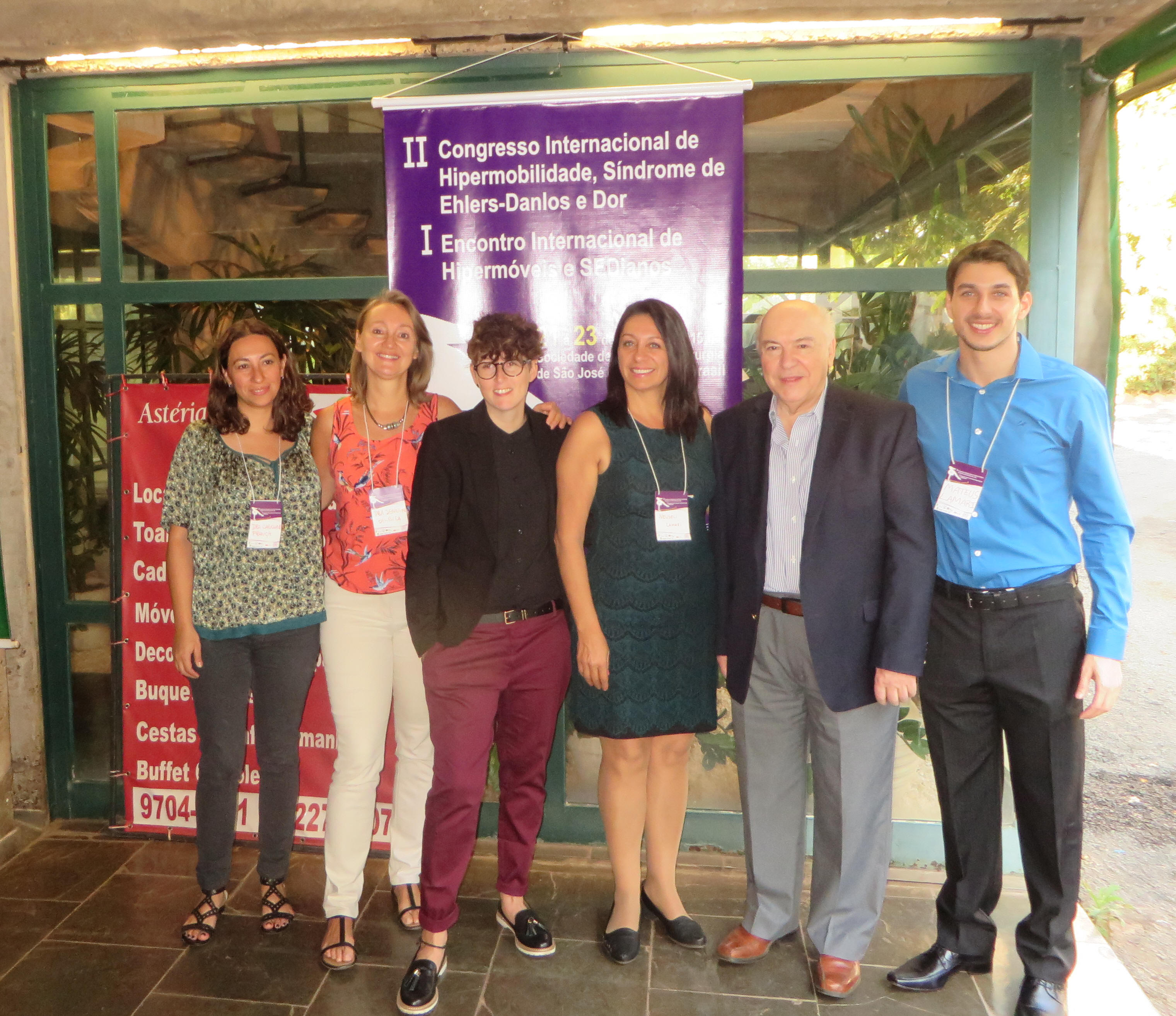
El Prof. Bravo fue invitado a participar en la segunda versión de este
congreso brasileño. El expuso sobre el Ehlers-Danlos tipo III, en la
primera charla habló sobre la fatiga, la somnolencia y la Disautonomia en el EDS-III y como
tratarlos, y en la segunda, presentó unas interesantes diapositivas sobre
como sospechar esta enfermedad. A este congreso....
Seguir Leyendo |
II° Congresso Internacional de Hipermobilidade. Síndrome de Ehlers-Danlos e
Dor Sao José do Rio Preto, Sao Paulo Brazil, August 21 - 23, 2015

Prof. Bravo was invited to participate in the second version of this
brazilian congress. He spoke about Ehlers-Danlos tipe III. His first speech
was on Fatigue, Somnolence and Disautonomia in SED-III and how to treat it,
and his second speech was about hot to suspect this disease, supported by a
great powerpoint presentation. This congress counted with the participation
of well known doctors, among which me must mention Jenneke Van den Ende, MD
(Belgium), Prof. Rodney Grahame (England), Lara Bloom (EDS United Kingdom),
Désirée Novaes (SED Brazil), and the Chilean Psychologist, Carolina
Baeza-Velasco. It was very pleasing to see the great interest on these
topics among the brazilian people. The success of this congress is mainly
due to the tremendous effort by Prof. Neuseli Lamari, who has been
interested in the Ehlers-Danlos subject for more than 25 years.
A special aspect worth noting about this Congress was the interaction of
patients and professionals that took place at the FAMERP institute


|
COLLOQUE MÉDICAL INTERNATIONAL FRANCOPHONE
Les
traitments du syndrome d'Ehlers-Danlos:
Avancées & Prospectives
Faculté de Médecine de Créteil - 7 mars 2015, Paris,
France

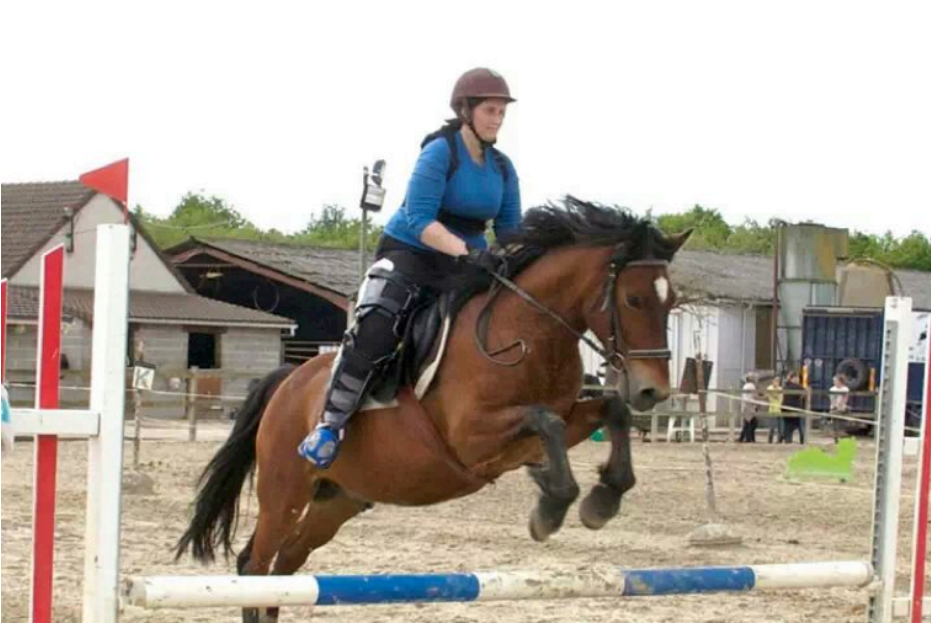
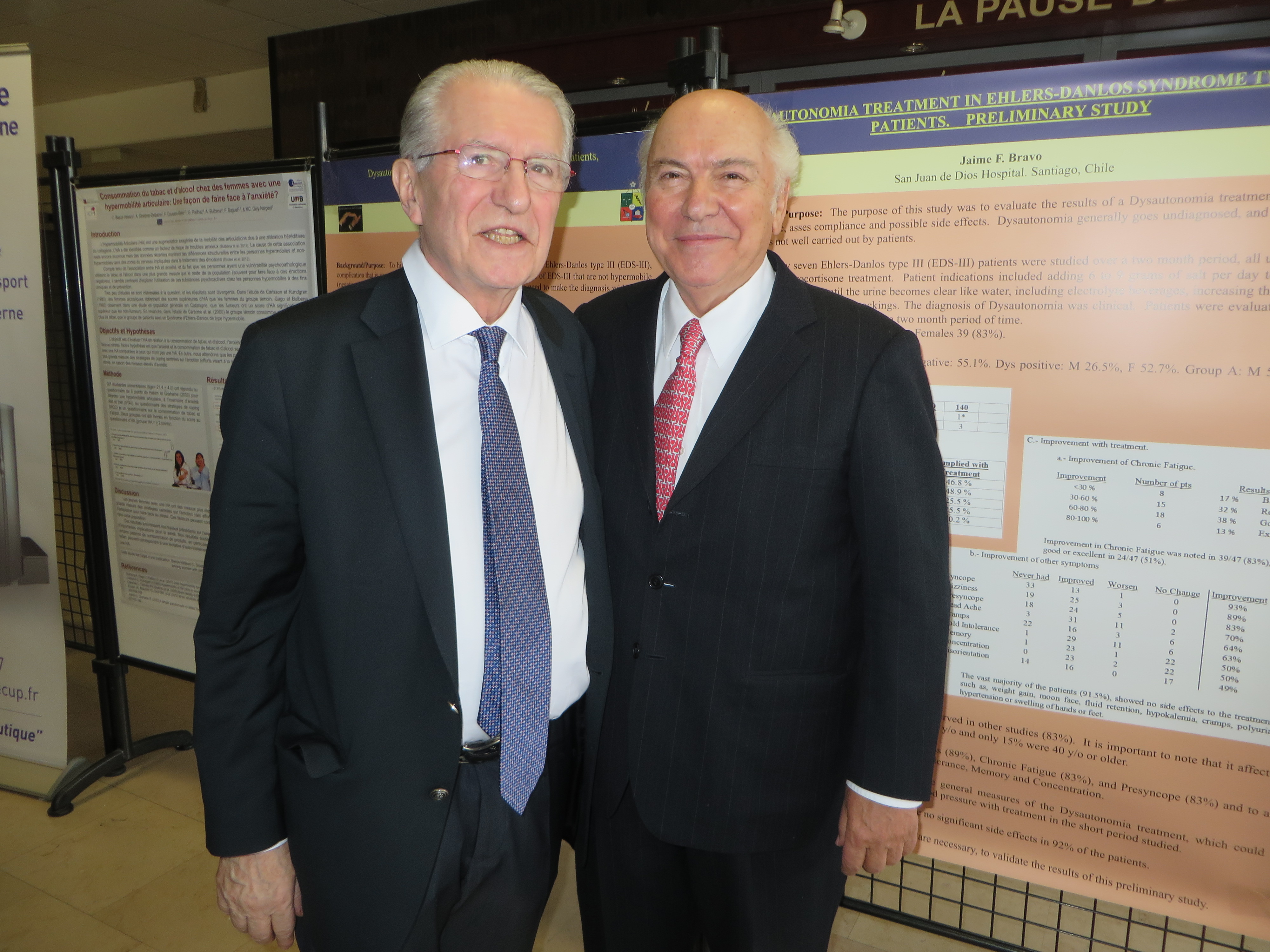
|
Logo
Asociación Normanda de
Afectados por Ehlers-Danlos |
Paciente con Ehlers-Danlos
rehabilitada |
Director del Coloquio, Prof. Claude Hamonet con el Prof. Jaime Bravo
|
El Prof. Bravo
fue invitado a participar en el Coloquio sobre el Síndrome de Ehlers-Danlos,
efectuado en la Universidad de Creteil, en Paris. Disertó sobre el
diagnóstico y tratamiento de la Disautonomía ( fatiga crónica, mareos y
desmayos ). Condición que es muy frecuente, especialmente entre mujeres
jóvenes con Ehlers-Danlos tipo III (80%). También presentó 2 posters
al respecto.
El Dr. tuvo la
oportunidad de participar en las consultas clínicas de connotados
especialistas de otras áreas, pero con especial interés en el Ehlers-Danlos
(Ginecólogos, Broncopulmonares, Neurologos, entre otros). Durante su
estadía, el Doctor Bravo tuvo la oportunidad de ver la confección de trajes
compresivos y administración de Oxígeno nasal para el tratamiento integral de la Disautonomía,
dirigida por la Ortopedista Elodie Vlamynck, programa del cual ella es pionera.
Quisiéramos
destacar la participación de la psicóloga chilena, residente en Paris,
Carolina Baeza-Velasco, quien presentó una interesante exposición sobre la
Ansiedad en los enfermos con el Síndrome de Ehlers-Danlos.
|
COLLOQUE MÉDICAL INTERNATIONAL FRANCOPHONE
Les
traitments du syndrome d'Ehlers-Danlos:
Avancées & Prospectives
Faculté de Médecine de Créteil - 7 mars 2015, Paris,
France
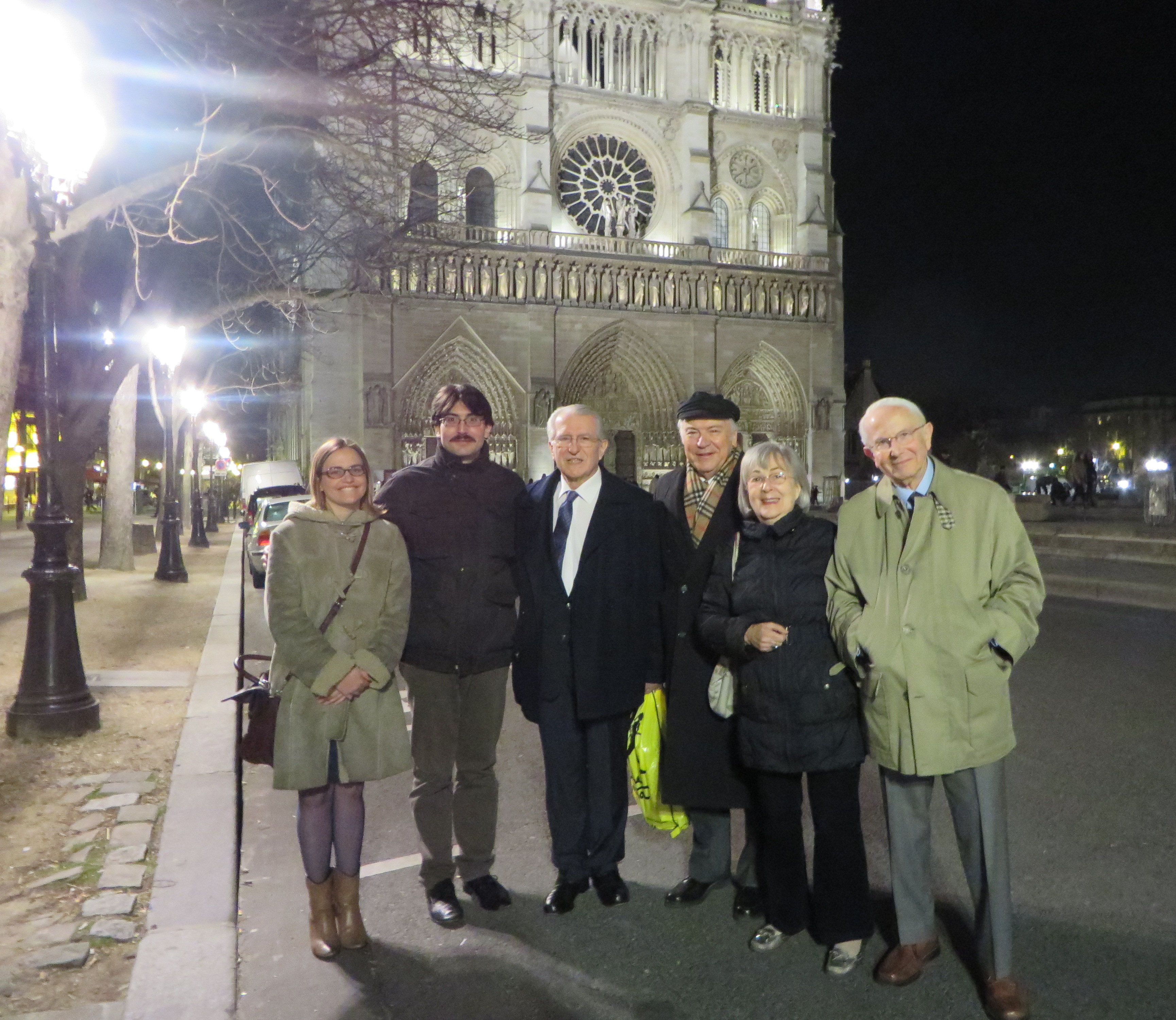
|
Rehabilitated Ehlers-Danlos patient |
Professors Bravo, Hamonet, Grahame and Castori
|
Prof. Bravo was
invited to participate in the Colloquium on Ehlers-Danlos Syndrome,
held at Creteil University in Paris. He spoke about...
|
CONGRESO ANUAL DE LA ASOCIACION
AMERICANA DE REUMATOLOGIA (ACR 2014)
14 al 19 de Noviembre, Boston, MA, EEUU
Grupo de Estudio del Síndrome de Hiperlaxitud Articular


El Prof. Bravo, por
séptimo año consecutivo, fue
co-coordinador junto al Prof. Rodney Grahame (UK) de este grupo de estudio.
Se discutieron los siguientes temas:
Síndrome de
Hiperlaxitud Articular e Hiperactividad Autonómica:
Relevancia en los Trastornos del Desarrollo
Neurológico, presentado por Jessica Eccles, MRCPsych.
Disautonomia y
Fatiga en la Hipermovilidad, presentado por Nelly
Ninis, MRCP, MD.
Manejo de la
Terapia Física de Adolescentes con Taquicardia
Postural Ortostática - en el Síndrome de Ehlers-Danlos
- Tipo Hipermovilidad, presentado por Jane Simmonds,
MCSP, MMACP.
|
AMERICAN COLLEGE OF
RHEUMATOLOGY (ACR 2014) ANNUAL MEETING
November 14th to
19th, Boston, MA, USA
 
Members of the 2014 study group
Professor Jaime Bravo MD., for the seventh year running
was co-coordinator of the Joint Hypermobility Study group alongside Prof.
Rodney Grahame (UK). This time, Prof. Claude Hamonet (France)
participated with us. The following subjects were discussed:
Joint Hypermobility and Autonomic
Hyperactivity: Relevance to Neurodevelopmental
Dissorders, presented by Jessica A Eccles MB BCh,
MRCPsych.
Dysautonomia and Fatigue in
Hypermobility, presented by Nelly Ninis MRCP MD
Physical Therapy Management of
Adolescents with Postural Orthostatic Tachycardia
Syndrome (PoTS) and Ehlers-Danlos Syndrome -
Hypermobility Type (EDS - HT), presented by Jane Simmonds MCSP, MMACP
|
|
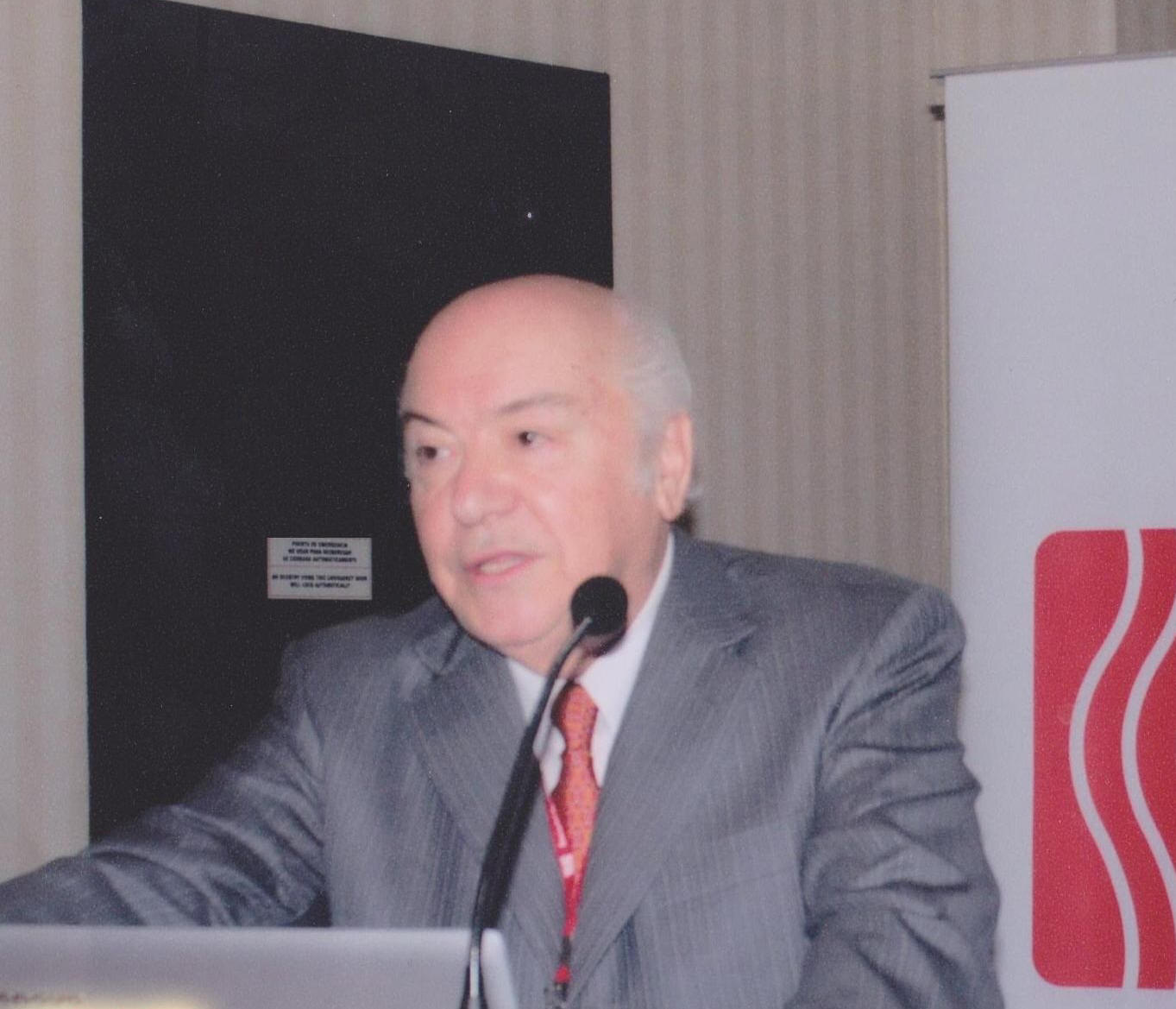
El Profesor Dr. Bravo fue invitado a participar en el Congreso Peruano de
Reumatología 2014, en Lima, Perú
|
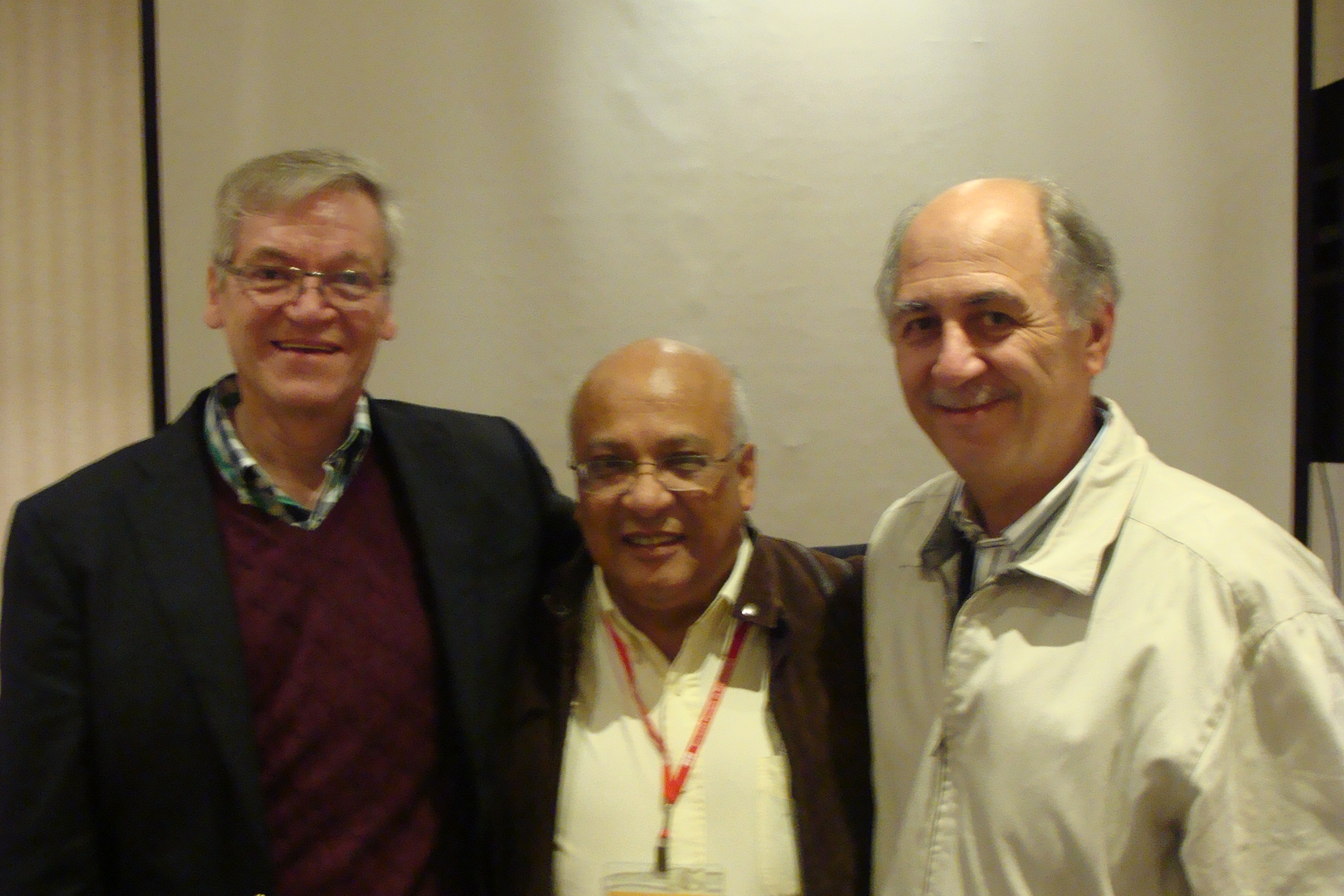
Prof. Jaime Bravo MD, was
invited to participate in the 2014 XVIII Peruvian Rheumathology Congress held in Lima Peru, between
September 17th and 20th. In this opportunity,
he dictated two lectures, first he spoke about Joint
Hypermobility, and later, he gave a speech about Dysautonomia.
He participated alongside
physicians from Argentina, Chile, Peru, Uruguay and Mexico.
|
XVIII Congreso de la Liga Panamericana de Asociaciones de
Reumatología
PANLAR 2014
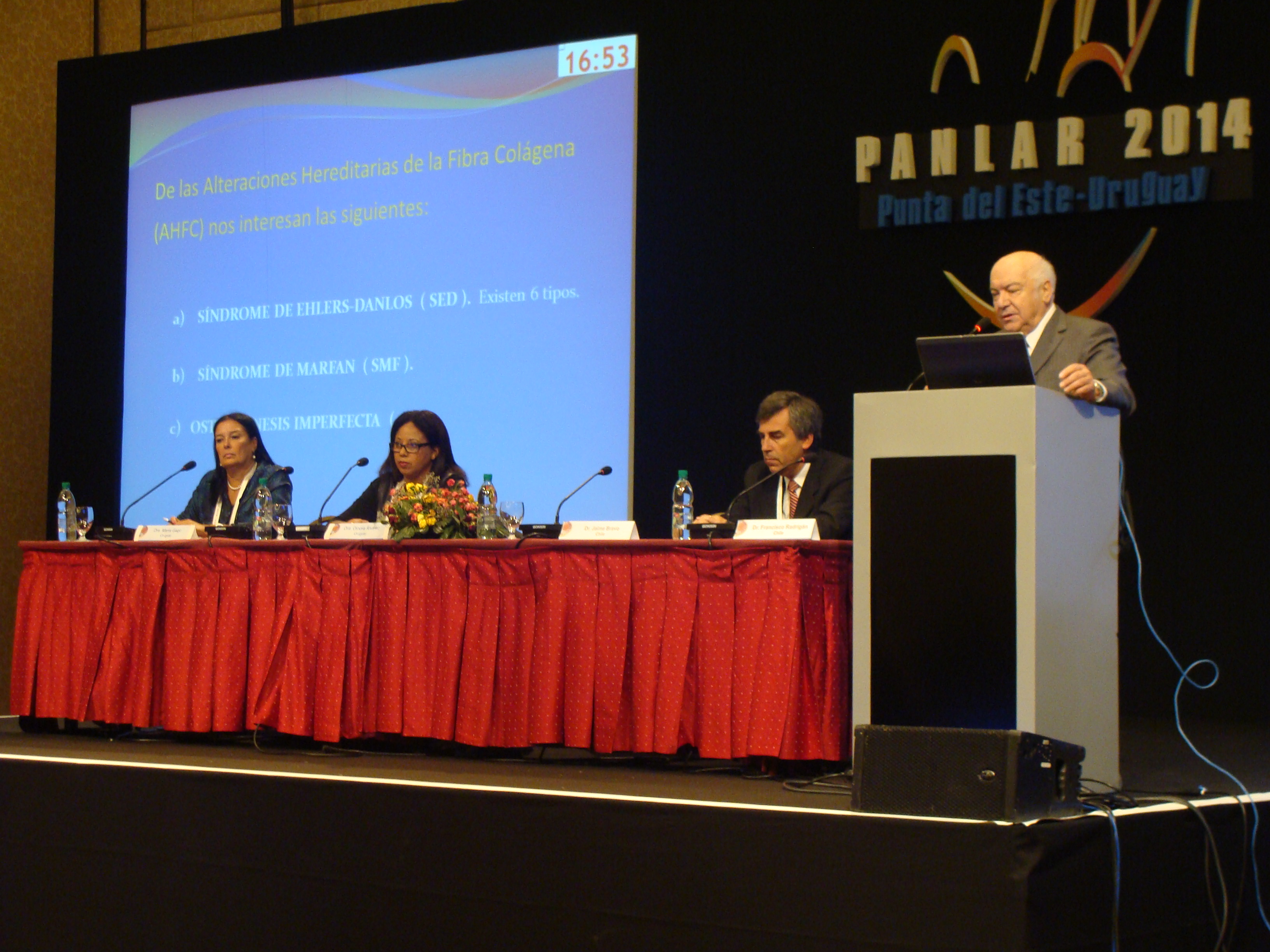
El
Dr.
Bravo fue invitado a participar en el Congreso PANLAR 2014 (Congreso de la Liga Panamericana de Asociaciones de
Reumatología) en Punta del Este, Uruguay, del 15 al 20 de Marzo del 2014. En esta oportunidad el
Dr. dictó una charla sobre la Hiperlaxitud Articular y presentó un póster sobre Disautonomia y Osteoporosis.
|
XVIII Panamerican Rheumatology Congress
PANLAR
2014
.JPG)
Dr.
Bravo was
invited to participate in the 2014 PANLAR
Meeting, in Punta del Este, Uruguay, from March
15th to 20th. In this opportunity
Dr.
Bravo gave a talk about Joint Hipermobility and
presented a poster about Dysautonomia and
Osteoporosis. |
I° Congresso Internacional Hipermobilidade.
Síndrome de Ehlers-Danlos e Dor
.jpg)
El
Dr.
Bravo fue invitado a
participar en el primer
Congreso Internacional de
Hipermovilidad – Síndrome de
Ehlers-Danlos y Dolor, que
se llevó a cabo en la ciudad
de Sao Jose do Rio Preto, en
Sao Paulo, Brasil, del 23 al
25 de agosto del 2013. En
esta oportunidad el
Dr.
presentó una charla como
conferencista sobre el tema
de la Disautonomia
secundaria al Síndrome de
Ehlers-Danlos tipo III (SED-III),
una charla sobre la Historia
natural y Criterios
Diagnósticos del SED-III, y
otra charla sobre la
relación entre la
Fibromialgia y el SED-III.
El congreso también contó
con una mesa redonda con
preguntas sobre estos temas,
donde él participó junto a
destacados especialistas
internacionales.
ENTREVISTA SOBRE HIPERLAXITUD EN TV BRASILEÑA
|
Ist
International
Congress on Hypermobility. Ehlers-Danlos
Syndrome and Pain

Doctor
Bravo was invited to
participate in the first International Congress
on Hypermobility, Ehlers-Danlos and Pain, held
at Sao Jose do Rio Preto, Sao Paulo, Brazil,
from August 23rd to 25th,
2013. In this opportunity, the Doctor gave a
talk on the subject of Dysautonomia secondary to
the Ehlers-Danlos Syndrome type III (EDS-III), a
speech about Natural History and Diagnostic
Criteria of EDS-III. He also gave another
conference about the relation between
Fibromyalgia and EDS-III. The Congress also had
a round table with discussions and questions
regarding these subjects, where he participated
alongside other international experts on the
subjects.
LOCAL BRAZILIAN TELEVISION JOINT HYPERMOBILITY
INTERVIEW
|
|
El
Dr.
Bravo acaba de regresar
de un exitoso viaje de trabajo/placer a Europa
donde tuvo la oportunidad de visitar las
ciudades de Barcelona, Montpellier, Salzburgo,
Viena y Londres.
En Barcelona, España,
agasajado por el Prof. Bulbena, dictó una charla
en la Asociación de Afectados por el Síndrome de
Ehlers-Danlos (Asedh), con una buena asistencia
incluyendo a un enfermo que viajó desde Islas
Canarias. Dicha charla tuvo una excelente
acogida y una mejor sesión de preguntas y
respuestas, para posteriormente pasar a un
pequeño coctel en su honor.
En Montpelier, Francia,
invitado por el Prof. Blotman, asistió al
Congreso Anual Francés de
Reumatología y también
se reunió con la psicóloga chilena Carolina
Baeza, quien se dedica al tema de la Ansiedad en
relación al Síndrome de Hiperlaxitud Articular y
que ha publicado importantes artículos tanto en
España como en Francia.
Las estadías en las ciudades
austriacas de Salzburgo y Viena, forman parte
del lado placer y relajo de este viaje, donde
con los distintos tours tuvo la oportunidad de
conocer estas hermosas y antiguas ciudades, con
sus parques, ríos, y catedrales, donde en todo
momento se difunde la maravillosa música de
Mozart. En Viena se destacan los caballos
Lipizzanos de la escuela de Equitación
Española. Aprovechando el grato verano europeo,
disfrutó de la gran calidad de las cervezas y de
las Frankfurters (enormes vienesas tipo
longanizas).
Lo más destacado de este viaje
fue su última etapa en Londres. Invitado por el
Prof. Grahame, lo hospedaron en el exclusivo
hotel “Chandos House” perteneciente a la Real
Sociedad Médica de Londres, y dio una charla en
el "The London and South East Hypermobility Club", que agrupa a
médicos y fisioterapeutas expertos en el estudio
de la Hiperlaxitud articular a nivel mundial.
El
Dr.
Bravo presentó su charla “Estudio Clínico
de 1700 pacientes con Ehlers-Danlos tipo III
(Síndrome de Hiperlaxitud Articular)”. En la
presentación se dio especial énfasis a la alta
frecuencia de Disautonomia (fatiga crónica) y
Osteoporosis en hiperlaxos jóvenes, seguida de
una extensa sesión de preguntas y respuestas
con un enriquecedor intercambio de experiencia
entre los asistentes. Como broche de oro a la
estadía fue la comida final organizada por un
selecto grupo de amigos, médicos y
fisioterapeutas, donde se pudo compartir el lado
más humano y cordial de cada uno de nosotros.
|
Dr.
Bravo has just returned
from a very successful trip business/pleasure to
Europe, where he visited the cities of
Barcelona, Montpellier, Salzburg, Vienna, and
London.
In Barcelona, as a guest of
Prof. A. Bulbena, he gave a lecture at the
Ehlers-Danlos Syndrome Support Group (Asedh),
with a very good gathering including a patient
that travelled from the Canary Islands. This
lecture was very well received, with an
excellent Q&A session and a later cocktail in
Dr.
Bravo’s honor.
In Montpellier, France, as a
guest of Prof. F. Blotman, he assisted to the
French Annual Rheumatology Congress, where he
also had the chance to meet with the Chilean
Psychologist Carolina Baeza, who has been
dedicated to the topic of Joint Hypermobility
Syndrome in relation to Anxiety, and who has
published several papers both in Spain and in
France.
The stay in the Austrian
cities of Salzburg and Vienna, is part of the
pleasure/relax side of this trip, where thanks
to the city tours he was able to see these
beautiful and antique cities, with their parks,
rivers and cathedrals, where at every moment
they play the beautiful Mozart music. In Vienna
he also saw the Lipizzaner horses of the Spanish
Horse Riding School. Enjoying the nice European
summer, he delighted himself with the great beer
and the delicious Frankfurters.
The high note of this trip
was its last leg in London, England. Invited by
Prof. R. Grahame as a Visiting Professor, he was housed at the exclusive
“Chandos House” hotel property of the Royal
Medical Society of London, and gave a lecture to
the London & South East Hypermobility Club, which gathers
international physicians and physiotherapists,
experts in Hypermobility. His presentation made
special emphasis on the high frequency of
Dysautonomia (Chronic Fatigue) and Osteoporosis
among young hypermobile patients, followed by an
extended Q&A session that allowed for an
enriching exchange of knowledge. Closing this
trip, was a final dinner organized by a select
group of friends, physicians and
physiotherapists, where we were able to share
our more human and cordial side.
|
|
El tener
vocación de servicio público y deseo de ayudar a
los enfermos, me ha llevado a tener esta página
web. Nuestra Página Web de
Reumatología ha
demostrado ser de mucha utilidad para un gran
número de enfermos que nos envían cartas de
muchos países de diversos continentes. El hecho
de que ya hayamos pasado de las 100.000 visitas
habla claro de la aceptación de este conveniente
medio de información. Yo contesto en promedio
unos 70 Emails mensuales, con la consiguiente
dedicación y agrado, pero indudablemente con una
gran exigencia de tiempo. Espero pode seguir
haciéndolo. Existen numerosos gastos para
mantener una Página Web, ya que además se
requiere de la experta ayuda de un Web máster.
Estos gastos ascienden a unos 4.000 dólares al
año y necesito ayuda para solventarlos. La
continuidad de esta página web peligra por la
falta de financiamiento y no quisiera tener que
solicitar apoyo de algún laboratorio (lo cual
sería relativamente simple) para poder evitar
influencias y conflictos de intereses. Cualquier
aporte que nos puedan hacer es bienvenido, para
poder continuar con esta cruzada de información
reumatológica, a la comunidad, especialmente
dedicada a la Hipermovilidad Articular y a la
Disautonomia (Fatiga crónica, mareos, falta de
energía y a veces desmayos). Como muchos de
ustedes ya han leído, estas enfermedades son muy
frecuentes y poco diagnosticadas. |
Having a public
service vocation and the will to help sick
people, has brought me to open this web page.
Our Rheumatology Web has demonstrated to be of
great help to a great number of patients, who
have sent us letters from many countries of
different continents. The fact that we have
surpassed the 100.000 visits speaks of the
acceptance of this convenient media of
information. I answer about 70 emails per
month, with dedication and pleasure to be of
service, but with a great demand on my time.
There are numerous expenses to maintain the Web
Page, since it requires de expert help of a Web
Master. Our expenses are about 4,000 dollars a
year and I need help to pay them. The
continuity of the web page is at risk, and I
would not like to ask any laboratory for their
help (which would be relatively simple) in order
to avoid any influences and conflicts of
interest. Any support that you can give us is
well received, to be able to continue this
medical information crusade, related to
rheumatologic problems, especially in relation
to Hypermobility and Dysautonomia (Chronic
Fatigue, dizziness and lack of energy), as many
of you must have read, since these conditions
are very frequent and not very diagnosed |
|
Llegó Marzo, y con él el fin de
las vacaciones, la vuelta al trabajo, a los
tacos y a los estudios. Esperamos que todos
ustedes hayan podido descansar y recuperar las
energías para el resto del año. Nosotros aquí
en la página web hemos retomado la senda de la
difusión de esta enfermedad con las pilas
recargadas.
El
Dr.
Bravo ha seguido
atendiendo a muchos enfermos con Disautonomia y
fatiga crónica de todo Chile y de otros países
de Latinoamérica, y reafirma su teoría que la
mayoría de los médicos piensan que la presión
arterial baja es beneficiosa, cuando en realidad
es la causa de dolores de cabeza, mareos, fatiga
crónica y a veces cuasi desmayos (o francos
desmayos). Curiosamente, estos mismos síntomas
son los que se ven en la Disautonomia, la que es
causada por el problema hereditario del
Colágeno, llamado Síndrome de Ehlers-Danlos tipo
III (SED III) (o también conocido como Síndrome
de Hipermovilidad Articular, SHA). Es
interesante saber que un alto porcentaje de los
pacientes que no son hiperlaxos pueden tener SED
III, y por lo tanto pueden también tener
Disautonomia. Siguiendo con esta idea, el
Dr.
Bravo cree muy posible que algunos niños
presenten estos síntomas, dado el carácter
hereditario de la enfermedad, y la
hiperactividad que algunos niños presentan
podría ser una manera de compensar la presión
arterial baja. Por lo general, en las consultas
médicas a ellos no se les toma la presión, con
lo que este cuadro pasa inadvertido, y además de
la presión baja y la fatiga crónica, estos niños
pueden presentar déficit atencional. La
Disautonomia causa una disminución del aporte de
oxigeno al cerebro, lo que podría causar una
falla de la memoria y baja capacidad de
concentración (déficit de atención).
El
Dr.
Bravo ha notado, luego de
tratar a varios pacientes jóvenes, que ellos han
mejorado mucho su rendimiento académico, se
encuentran con mejor ánimo, y en general el
entorno familiar está más contento.
Esto lo ha
llevado a pensar que una de las causas de los
bajos resultados en la Prueba de Selección
Universitaria (PSU), sobre todo entre las
mujeres, podría ser por causa de la Disautonomia
no diagnosticada. |
March has arrived
in the southern hemisphere, and with it the end
of vacations, back to work, traffic jams, and
schools start. We hope that you have all been
able to rest and charge up some energies for the
rest of the year. Here at the web page, we have
resumed our quest to spread the word about this
disease with all our batteries fully loaded.
Dr.
Bravo has continued
seeing many patients with Dysautonomia and
Chronic Fatigue from all over Chile and other
Latin-American countries, and reassures his
theory that most physicians think that having
low blood pressure is a good thing to have, when
the truth is that it is the cause of headaches,
dizziness, chronic fatigue and at times
syncope. Interestingly enough, these are the
same symptoms as Dysautonomia, which is caused
by the hereditary Colagen problem, called
Ehlers-Danlos Syndrome Type III (EDS-III) (also
known as Joint Hypermobility Syndrome, JHS). It
is interesting to know that a high percentage of
the NON hypermobile patients can have EDS-III,
and thus can also have Dysautonomia. Following
this idea,
Dr.
Bravo believes possible that some
children present these symptoms, given the
disease hereditary component. The hyperactivity
that some children manifest could be a way to
compensate for their low blood pressure.
Generally in the doctor’s office, their blood
pressure is not tested, with which this
condition is unrecognized. Besides the low
blood pressure and the chronic fatigue, these
children may also present attention deficit
syndrome. Dysautonomia causes a decrease in the
brain’s oxygen supply, which could cause
memory loss and low concentration episodes.
Dr.
Bravo has
noticed, after treating some younger patients
that they have improved their memory and
concentration, which is reflected in obtaining
better grades in school, that they have a better
mood, and their families are much more content
overall. |
|
Balance del año
2010.
El año que
termina ha sido un buen año para nuestra cruzada
de ayuda a los enfermos y de diseminación de
información sobre las enfermedades del tejido
colágeno, en especial el Síndrome de Ehlers-Danlos
tipo III (SED III), llamado también Síndrome de
Hiperlaxitud Articular (SHA). El hecho de que
hasta la fecha hayamos recibido más de 94 mil
visitas, demuestra el interés que este tema
despierta. Debido a la información que aporta
este sitio web, han concurrido a la consulta del
doctor enfermos de varios países
latinoamericanos. Cada día contestamos más
preguntas a pacientes de todas partes del mundo,
y en Octubre recién pasado, respondimos 74
emails de ayuda a los enfermos.
Publicamos un
capitulo sobre Disautonomia en el libro
“Hypermobility, Fibromyalgia, and Chronic Pain”,
que se acaba de publicar en el Reino Unido. El
doctor publicó un artículo en la revista chilena
de
reumatología con una colección de fotografías
que permiten identificar a los enfermos
hiperlaxos y sospechar y diagnosticar
precozmente el SED III. Con la idea de que
se conozca mejor el hecho de que personas
no-laxas puedan también tener la misma enfermad
hereditaria, lo que puede causar problemas
tales como: hernias, rupturas de tendones,
prolapsos, etc., estamos cambiando el nombre de
Síndrome de Hipermobilidad Articular (SHA) a
Síndrome de Ehlers-Danlos tipo III (SED III).
Por tercer año consecutivo, el
Dr.
Bravo fue
coordinador del grupo de estudio de la
Hiperlaxitud en el congreso del Colegio
Norteamericano de
Reumatología llevado a cabo en
la ciudad de Atlanta, Georgia, en el mes de
Noviembre. Hemos dado más importancia al
tratamiento de la
ansiedad y depresión en el SED III, y
próximamente se presentará un póster en París,
Francia, en conjunto con la psicóloga Carolina
Baeza.
El
Dr.
Bravo ha
lanzado su teoría de que la Fibromialgia es
parte del SED III, y no una entidad por si sola.
El conocimiento
sobre la hiperlaxitud y sus complicaciones ha
aumentado notablemente el interés por este tema
en el público en general, y ahora es más
frecuente escuchar sobre esta condición en los
medios informativos. |
2010 Balance
The year that is
ending has been a good year for our crusade to
increase patient awareness and expand the
information about collagen tissue diseases,
specially about the Ehler-Danlos Syndrome Type
III (EDS-III), also called Joint Hypermobility
Syndrome (JHS). The fact that our web site has
had over 94 thousand hits throughout time, shows
the interest this subject matter arouses.
Given the information found herein, patients
from all over Latin America have visited the
doctor’s private practice. Every day we answers
questions sent in by patients from all over the
world, and last October, a total of 74 emails
were replied with help to them.
We published an
article about Dysautonomia in the book
“Hypermobility, Fibromyalgia and Chronic Pain”,
which has been recently published in the United
Kingdom. The doctor published an article in the
Chilean Rheumatology Journal with a collection
of pictures that allow to identify hypermobile
patients and suspect and early diagnose of SED
III. With the idea to improve the doctors and
public understanding that non-hypermobile
patients can also have this hereditary disease,
which can cause problems such as: hernias,
tendon ruptures, prolapses, etc., we are
changing the name of this condition from Joint
Hypermobility Syndrome (JHS) to Ehlers-Danlos
Syndrome Type III (EDS-III).
During this year
the Pan-American Arthritis Meeting (PANLAR) was
held in Santiago, Chile, and in relation to our
theme, professors Antonio Bulbena (Spain) and
Peter Byers (USA) were invited to give lectures.
For the third year in a row,
Dr.
Bravo was
summoned to coordinate the Hypermobility Study
Group at the 2010 ACR Meeting in Atlanta,
Georgia, during the month of November. Lately
we have been giving more importance to the
treatment of anxiety and depression in EDS-III,
and next month we will be presenting a poster in
Paris, France in that regard, in conjunction
with the psychologist Carolina Baeza.
Dr.
Bravo has
presented his theory that Fibromyalgia is part
of EDS-III, and not an entity by itself.
The knowledge
about Hypermobility and its complications has
notably increased the interest for this subject
in the general public, and it is know more
frequent to hear about this condition in the
news media. |
|
El Prof.
Bravo acaba de
participar en el Congreso Anual del Colegio
Norteamericano de
Reumatología (ACR - 2010) en
Atlanta, Georgia, EE.UU., del 6 al 11 de
noviembre. Nuevamente, y por tercer año
consecutivo, fue, junto al Prof. Rodney Grahame
(Inglaterra), coordinador de los 2 grupos de
estudio sobre la Hiperlaxitud Articular. Dio
una charla sobre el tratamiento de la
Disautonomia (Fatiga Crónica) en el Síndrome de
Hiperlaxitud Articular (SHA). Además,
presentó su colección de diapositivas con las
características típicas del Síndrome de
Hiperlaxitud Articular, que ahora se prefiere
llamar Síndrome de Ehlers-Danlos tipo III (SED-III),
debido a que hay muchas personas con esta
enfermedad que no tienen hipermovilidad
articular. Una apropiada aplicación de
estas características, permiten un diagnostico
visual preliminar de esta enfermedad.
La consulta del Profesor
Bravo se
ha constituido en un "Centro de Referencia
Internacional de la Hipermovilidad Articular",
ya que durante los últimos dos meses, vinieron
expresamente a su consultar su opinión a
Santiago de Chile, pacientes de Bolivia, Brasil,
Colombia, México y Panamá.
|
Professor
Bravo
has recently participated in the American
College of Rheumatology (ACR 2010) Annual
Meeting held in Atlanta, Georgia, from November
6th until the 11th. For the third year
running he was, alongside Prof. Grahame, the
coordinator of the two Joint Hypermobility Study
Groups. He talked about the "Treatment of
Dysautonomia (Chronic Fatigue)", concluding that
it is usually undiagnosed, in spite that its
treatment is very efficient. Furthermore,
he presented his collection of slides on the
characteristic features of the Joint
Hypermobility Syndrome (JHS), which, well
applied, permit an early visual diagnosis of
this condition. He also mentioned that it
is preferable to call this condition Ehlers-Danlos
Syndrome type III, since there are many patients
with this disease but don't present joint
hypermobility.
Professor
Bravo's
private practice has become an "International
Joint Hypermobility Referral Center" since for
the last couple of months, people have travelled
from Bolivia, Brazil, Colombia, Mexico, and
Panama, to Santiago, Chile, solely to get his
opinion.
|
|
En octubre del 2010 saldrá a la venta en
Inglaterra el libro "Hypermobility, Fibromyalgia
and Chronic Pain"
("Hipermovilidad, Fibromialgia y Dolor
Crónico), de los autores Hakim, Kerr y Grahame,
el libro más importante sobre este tema.
En él aparece el capítulo sobre Disautonomia
(Fatiga Crónica, Mareos y casi desmayos) escrito
por el Prof.
Bravo. En el enfatiza la alta
frecuencia de la Disautonomia especialmente en los hiperlaxos
menores de 30 años
(70% de las mujeres y el 40 % de los hombres).
El tratamiento de esta condición, por lo general
no diagnosticada, es muy
eficaz y mejora la calidad de vida del enfermo y
su entorno.
También contribuyó en el capitulo 2 del Prof.
Grahame sobre "What is the Joint Hypermobility
Syndrome, JHS from the cradle to the grave"
("Que es el Síndrome de Hiperlaxitud Articular,
SHA de la cuna a la tumba"). En el
artículo, ambos doctores destacan la alta
frecuencia del SHA tanto
en Chile, como en
Inglaterra, y hacen énfasis en que esta
condición pasa sin ser diagnosticada.
Acá
en Chile, en el último número
de la revista chilena de
Reumatología (Vol. 26,
N2) aparece un artículo del Prof.
Bravo,
titulado "Síndrome de Ehlers-Danlos tipo III
(SED-III), llamado también Síndrome de
Hiperlaxitud Articular (SHA): Epidemiología, y
manifestaciones clínicas". Este detallado
artículo de los síntomas y signos de SED-III,
está ilustrado con muchas fotografías que
destacan los signos que permiten sospechar de
este diagnóstico. Esto ayudará a los
médicos a diagnosticar esta enfermedad que por
lo general pasa desapercibida.
|
In October 2010, the most relevant book about hypermobility, "Hypermobility, Fibromyalgia and
Chronic Pain" by the authors Hakim, Kerr and
Grahame, will start being sold. In it,
Prof.
Bravo is the author of a chapter about Dysautonomia (Chronic Fatigue, Dizziness and pre
Symcope). In this article, he emphasizes
the high frequency of Dysautonomia specially in the
hypermobile patients younger than 30 years old
(70% of women and 40% of men). The
treatment for this generally undiagnosed
condition is very effective
and improves the patients quality of life, and
that of its close ones.
He also
contributed in
Dr. Grahame's chapter about "What
is the Joint Hypermobility Syndrome, JHS from
the cradle to the grave". In the article,
both doctors emphasize the high prevalence of
JHS both in Chile as in the UK, and they
highlight that fact that this condition usually
goes undiagnosed.
Also,
here in Chile, in the last number of the Chilean
Reumatology Journal (Reumatologia, Vol 26, N2),
there appears an article by Prof.
Bravo entitled
"Ehlers-Danlos Syndrome type III (EDS-III), also
known as Joint Hypermobility Syndrome (JHS):
Epidemiology and clinical manifestations" with
an abstract in english. This detailed
article about the signs and symptoms of EDS-III
contains many characteristics photographs of
these patients, which allows for a better visual
diagnosis. This will help physicians
diagnose this condition that usually goes
undiagnosed.
|
|
En Santiago,
Chile, del 25 al 28 de abril, se desarrolló exitosamente el
Congreso Panamericano de
Reumatologia (PANLAR)
2010. En esta ocasión se contó con
la asistencia de destacados especialistas de
todas las Américas interesados en la
Reumatología.
La participación del
Dr.
Bravo
comenzó con la presentación de un Póster
titulado "Síndrome de Ehlers-Danlos tipo III:
Una Revisión Clínica de 1606 pacientes".
Posteriormente, junto con el
Dr. Peter Byers (EEUU)
y el
Dr. Antonio Bulbena (España), presentó un
simposio titulado "Síndrome de
Hipermovilidad
Articular" (SHA).
El simposio comenzó con una
mirada desde la Genética de los Tejidos
Conectivos, presentado por el Prof. Byers.
Posteriormente este fue seguido con una
discusión de las características clínicas de
esta enfermedad, mediante la presentación del
Prof.
Bravo de diapositivas destacando los
signos que permiten sospechar el diagnóstico del
SHA (Ehlers-Danlos tipo III). El simposio
culminó con la presentación del Prof. Bulbena,
quien se refirió a la frecuente asociación de
Depresión y Ansiedad con la Hiperlaxitud.
Los panelistas quedaron muy satisfechos por el
alto número de asistentes y el marcado interés
demostrado por quienes participaron en este
simposio.
La prestigiosa publicación de la Asociación
Médica de Chile, la “Revista Médica de Chile”,
en su número de Noviembre del 2009, acaba de
publicar una puesta al día sobre el Síndrome de
Ehlers-Danlos (SED), con especial énfasis en el
Síndrome de Hiperlaxitud Articular (SHA), del
Dr.
Bravo. En él, destaca la necesidad de que se
conozca mejor esta enfermedad, la que puede
producir problemas de salud importantes, y que
por lo general pasa sin ser diagnosticada.
|
The Panamerican
Rheumatology Congress (PANLAR) 2010 was
succesfully held from April 25th until the 28th
in Santiago, Chile. Prominent Rheumatology
Specialists from all of the Americas were
present in this occasion.
Dr.
Bravo's
participation began with the presentation of a
Poster entitled "Elhers-Danlos Syndrome type III:
A Clinical Review of 1606 patients." Later,
alongside
Dr. Peter Byers (USA) and
Dr. Antonio
Bulbena (SPAIN), presented a Symposium entitled
"Joint Hypermobility Syndrome" (JHS).
The Symposium
began with a review of the Genetics of the
Connective Tissues, lead by Prof. Byers.
This was followed by a discussion of the
clinical characteristics of JHS, presented by
Prof.
Bravo, who projected his slideshow
highlighting the signs that permit the suspicion
of JHS (Ehlers-Danlos type III). This
symposium ended with Prof. Bulbena's
presentation who made reference to the frequent
association of Depression and Anxiety with JHS.
The panelists were satisfied with the high
number of participants and their level of
interest in this topic.
|
|
TERREMOTO
EN
CHILE
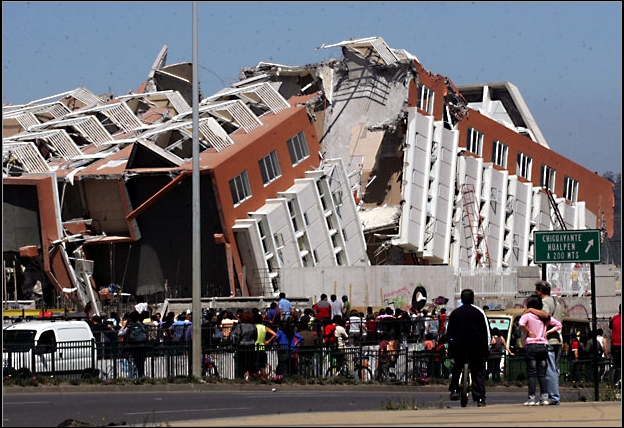

Alcanzó a rescatar sólo su
bandera.
He only
managed to rescue his flag.
EARTHQUAKE
IN CHILE |
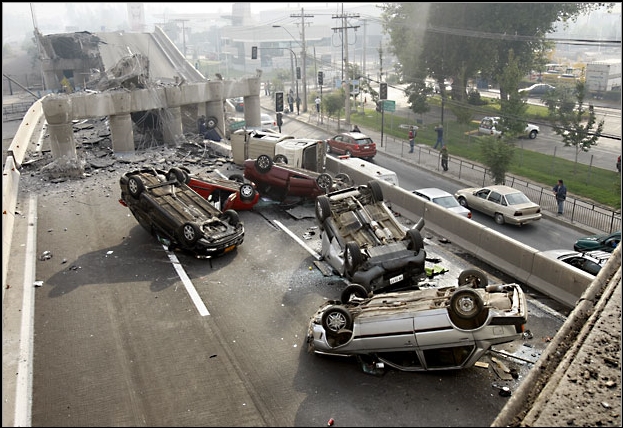
Devastador
terremoto grado 8,8 en escala de Richter, 800 veces
más potencia liberada que el terremoto de Haiti. La
devastación es muy importante en las zona centro sur
del país, con la destrucción de carreteras, puentes,
hospitales, iglesias, aeropuertos y hoteles,
poblados enteros están en el suelo. La zona costera
de 4 regiones severamente dañada además por varios
maremotos. La tragedia afecta directa e
indirectamente a más de 2 millones de habitantes y
se estima que para la reconstrucción se necesitaran
alrededor de US$30.000 millones. Además
de la falta de servicios básicos (falta de agua,
electricidad y telecomunicaciones), se suma el
complejo daño psicológico de la población.
Solicitamos
vuestra cooperación con las distintas iniciativas
económicas y de solidaridad para que nuestro querido
país se ponga de pie nuevamente lo antes posible.
A
devastating 8.8 in the Richter scale earthquake hit
Chile on February 27th, it was 800 times more
powerful than the Haiti earthquake. The
devastation is very severe in central and southern
part of Chile, with the destruction of highways,
bridges, hospitals, churches, airports and hotels,
entire communities are on the ground. The
costal area of 4 chilean regions were severely hit
by repeated tidal waves. The tragedy hits
directly or indirectly more than 2 million people,
an the reconstruction cost is estimated to be more
than US$30 billion. Besides the lack of basic
services (lack of water, electricity and
telecommunications), we must add the serious
psychological effect on the population.
We
would appreciate yours and everybodies contribution
to the different economic and solidarity initiatives
to help our loved country bounce back to its feet as
soon as it may be.
Donations can be made
online from all over the world in World Vision,
www.wvi.org. |
|
Durante el mes de Octubre, el
Dr.
Bravo asistió
a la reunión científica anual del Colegio
Americano de
Reumatología en Filadelfia,
Pennsylvania, EEUU, donde presentó su trabajo "SIGNS
AND SYMPTOMS OF JOINT HYPERMOBILITY SYNDROME (JHS)
TO CONSIDER WHEN DIAGNOSING THIS CONDITION",
basado en 1400 enfermos con el Síndrome de
Hiperlaxitud Articular. En el, destaca los
síntomas y signos que alertan al diagnóstico de
esta enfermedad que en general pasa sin ser
diagnosticada.
Nuevamente el
Dr.
Bravo fue coordinador de los
dos grupos de estudio del Síndrome de
Hiperlaxitud Articular, en el que participaron
los médicos mas destacados en este tema.
En el intertanto, aqui
en Chile, el
Dr.
Bravo
fue nombrado Profesor de la Facultad de Medicina
de la Universidad de Chile.
Si no han visto ésta Página Web últimamente, les
recomiendo verla, ya que la reviso semanalmente.
Como pueden ver aquí, sigo estrechamente ligado
con la gente que más sabe en el mundo sobre este
problema, por lo que he recibido reconocimiento
internacional. |
From
October 16 to 21st, 2009,
Dr.
Bravo participated
in the 2009 Annual Scientific Meeting of the
American College of Rheumathology, held in
Philadelphia, Pennsylvania. He presented
the paper "SIGNS
AND SYMPTOMS OF JOINT HYPERMOBILITY SYNDROME
(JHS) TO CONSIDER WHEN DIAGNOSING THIS CONDITION",
based on 1400 JHS patients. In the study,
Dr.
Bravo points out several important signs and
symptoms that facilitate the diagnosis of this
usually undiagnosed condition.
Again
this year, along side Prof. Rodney Grahame, he
was the coordinator for the two Joint
Hypermobility Syndrome Study Groups, which had
the participation of the most prominent
specialist in this subject.
In
the meantime, here in Chile,
Dr.
Bravo has been
named Professor at the Univerisity of Chile
Medical School.
|
|
Como
algunos de Uds. ya saben, en los últimos años
me he dedicado al estudio de una enfermedad muy
frecuente, pero pocas veces diagnosticada, el Síndrome
de Hiperlaxitud Articular (SHA), una enfermedad
hereditaria del Tejido Colágeno, que afecta al
40% de la población Chilena. Un tipo de estas
enfermedades es el Síndrome de Ehlers- Danlos
Vascular, que es más grave.
El
SHA existe en el 15% de la población mundial, y
es más frecuente
en Chile y tal vez en otros países
latinos.
Según mi experiencia (estudiado y
publicado más de 2.000 enfermos), esta sería
la causa de que los niños pasen con esguinces y
sub-luxaciones y los deportistas pasen
lesionados. Además es causa de Artrosis precoz,
Osteoporosis precoz, Fibromialgia y Disautonomia
(Cansancio y fatiga crónica a veces con
desmayos, debida a presión arterial baja.)
|
As
you know I have been investigating a very
frequent yet usually undiagnosed condition
called the “Joint Hypermobility Syndrome”
and have seen and published about 2,000
patients, for which I have received
international recognition. |
|
El
Dr.
Bravo deja de atender en la Clínica Arauco
a partir del 1° de Agosto del 2009. Su intención
es agrupar a todos sus enfermos en su Consulta
particular. La razón de este cambio, es su
deseo de seguir dando a sus enfermos la atención
que les ha brindado por años.
La
nueva política de Clínica Arauco es que a los
enfermos se les cite cada 15 minutos. El
Dr.
Bravo estima que en tan poco tiempo no se puede
atender bien a un enfermo reumatológico, ni
menos aún, hacer una detallada evaluación
reumatológica de los enfermos nuevos, como lo
hace habitualmente, por lo que este tipo de práctica
no calza con su forma de trabajar.
Se
les sugiere a los enfermos que deseen seguir
atendiéndose con el
Dr.
Bravo, que al pedir
hora en su Consulta ((2) 570-8505 o (2)
232-2768) le adviertan a la secretaria (Leonor),
que provienen de Clínica Arauco, para obtener
una copia de su ficha reumatológica y acordar
el precio de las futuras consultas.
|
Starting
August first,
Dr.
Bravo will no longer work at
Clinica Arauco. He is planning to see all his
patients at his private office. The reason for
this change is his desire to continue giving his
patients the type of care that he has given them
for years.
The
new policy at Clinica Arauco is to give
appointments for only 15 minutes.
Dr.
Bravo
feels that in such short period of time it is
not possible to see well a rheumatological
patient, further more, it is impossible to do a
detailed rheumatological evaluation of the new
patients, like he does usually. Since he wants
to continue serving his patients well, he has
decided not to continue working at Clinica
Arauco. |
|
El
verano está terminando aquí en el hemisferio
sur y hemos retomado nuestra senda del
conocimiento con mucho entusiasmo.
Durante este periodo, el
Dr.
Bravo, en
conjunto con el
Dr. Gonzalo Sanhueza, han
escrito un capitulo para un libro de los
doctores Grahame y Hakim.
El capítulo se titula “Fatiga Crónica
en el Síndrome de Hiperlaxitud Articular
(SHA)”.
Este
será el segundo libro que se refiere al tema de
la hiperlaxitud articular y será editado en el
Reino Unido hacia fines de año. En el capitulo,
el
Dr.
Bravo destaca la gran frecuencia
de
la Disautonomia (Fatiga Crónica, Mareos y
Desmayos) en el SHA, condición que produce una
mala calidad de vida y que generalmente no es
diagnosticada.
Con
el título “Síndrome de Ehlers-Danlos
(SED) con especial énfasis en el síndrome
de Hiperlaxitud Articular (SHA)”, la revista Médica
de Chile, publicará próximamente este artículo
de revisión sobre el tema del
Dr.
Bravo.
Esta revista es la revista oficial del
Colegio Médico de Chile.
-----
----- -----
Las
Termas de Panimávida, en la séptima región de
Chile, conocidas internacionalmente por el valor
de sus aguas termales, y lugar donde el
Dr.
Fernando
Bravo, padre del
Dr. Jaime
Bravo, fue
el investigador e impulsor de las termas durante
30 años. (Ver Homenaje a Mi Padre, mas abajo).
La
artesanía en Crin, es un arte típico de la
zona con reconocimiento internacional.
Las
mujercitas (foto superior) son obra de la Sra.
Amanda Salas, y el Pesebre en Crin, es obra
de su hija, Hilda Díaz, ambos trabajos han
sido galardoneados en competencias de
artesanía. |
Summer
is coming to an end here in the southern
hemisphere, and we have resumed our path of
knowledge with a lot of enthusiasm. During
this period,
Dr.
Bravo together with
Dr. Gonzalo
Sanhueza have written a chapter for a book by
Dr. Grahame and
Dr. Hakim. The title of
the chapter is” Chronic Fatigue in the Joint
Hypermobility Syndrome (JHS)”. This will
be the second book that refers to hypermobility
and it will be published in the UK towards the
end of the year. In this chapter,
Dr.
Bravo points out the great frequency of
Dysautonomia (Chronic Fatigue, Dizziness and
Syncope) in JHS, a condition that produces a
poor quality of life, and generally goes
undiagnosed.
Dr.
Bravo also contributed with a review article to
the Chilean Medical Journal, about
Hypermobility, entitled “Ehlers-Danlos
Syndrome (EDS) with special emphasis in the
Joint Hypermobility Syndrome (JHS)”.
This journal is the official journal of the
Chilean Medical College.
“Termas
de Panimávida”, located in Chile’s seventh
region, are well-known in Chile and abroad for
being one of the oldest and finest hot springs
and resort spas in the country, and also a place
where
Dr. Fernando
Bravo,
Dr.
Bravo’s father,
was an investigator and promoter of the spa and
the benefits of its thermal waters for 30 years.
( See “Homenaje a Mi Padre” --text in
spanish -- below).
The
Crin handcraft is a world renowned typical art
of this area of Chile,
“The Women” (upper photo) were made by Mrs.
Amanda Salas, and the “Birth of Christ” was
made by her daughter, Hilda Díaz. Both
works have won awards in craftwork competitions.
|
|
Hacia
fines de Octubre y principios de Noviembre, el
Dr.
Bravo asistió al Congreso Anual de
Reumatología de EEUU (ACR 2008) en San
Francisco, y después al Congreso Chileno de
Reumatología (SOCHIRE 2008) en Puerto Varas.
Por
segundo año consecutivo, el
Dr.
Bravo fue
coordinador de dos Grupos de Studio del Síndrome
de Hiperlaxitud Articular (SHA), contando
nuevamente con la participación de los más
connotados especialistas internacionales en este
tema (Ver Foto del mes).
Principalmente
se discutieron dos grandes temas, primero la
asociación de la Fibromialgia (FM) con el SHA y
segundo tratar de ver si el SHA es lo mismo que
el Síndrome de Ehlers Danlos Hipermovible
(SED-III).
Hay un grupo de autores que consideran
que la FM se asocia al SHA, el
Dr.
Bravo va más
allá y piensa que la FM es parte del SHA.
También expuso un estudio en formato de
póster, titulado “ Densidad Mineral Ósea
(DMO) baja y Disautonomia en adolescentes y
enfermos jóvenes con Ehlers-Danlos tipo III:
Estudio Clínico de 90 pacientes”.
Este estudio destaca la presencia de
Osteoporosis incluso en hombres jóvenes.
Se
encontró DMO baja en ambos sexos en el 64%,
incluyendo un 13 % con osteoporosis, y en el 66%
de los pacientes estudiados se encontró
Disautonomia (Cansancio y Fatiga Crónica).
De
vuelta
en Chile, en Puerto Varas, al
Dr.
Bravo
le correspondió exponer acerca de como examinar
al enfermo hiperlaxo, y también presentó un póster
donde en un estudio con más de 1000 pacientes
con SHA, al estudiar los
menores de 30 años, encontró Disautonomia en el 72% de las
mujeres y en 44% de los hombres.
|
Dr.
Bravo recently attended the ACR 2008 in San
Francisco and the Annual Chilean Rheumaological
Society Meeting in Puerto Varas, Chile.
For
the second year,
Dr.
Bravo was the coordinator
of two Joint Hypermobility Syndrome (JHS) Study
Groups, with the participation of the most
outstanding international specialists in this
field (see picture of the month).
Mainly two significant subjects were discussed.
First, the association of Fibromyalgia (FM) with
JHS, and second, whether if JHS and Hypermobile
Ehlers-Danlos Syndrome (EDS - III) are the same
thing. There is a group of authors which
feel that there is a strong association between
FM and JHS,
Dr.
Bravo goes further and states
that FM is a part of JHS. He also
presented a poster, “LOW BONE MINERAL DENSITY
(BMD) AND DYSAUTONOMIA IN ADOLESCENTS AND YOUNG
PATIENTS WITH EHLERS-DANLOS TYPE III: Clinical
Study with 90 Patients” which shows that young
males have Osteoporosis. A low BMD was
noticed in 64% in patientes of both sexes,
including osteoporosis in 13%, and 66% of the
patients had Dysautonomia (Tiredness and Chronic
Fatigue).
Back
in Chile, at Puerto Varas,
Dr.
Bravo presented a
discussion on how to examine a hypermobile
patient. He also presented a poster where,
in a study involving more than 1000 patients
with JHS, he found Dysautonomia in 72% of women
and in 44% of men, of ages younger than 30 years
old. |
|
Finalmente el tema que el
Dr.
Bravo ha impulsado desde un tiempo a la fecha ha recibido el lugar que se merece, y por vez primera se realizó una Sesión Plenaria, a cargo del doctor, sobre la Hiperlaxitud Articular en el Congreso Panamericano de
Reumatologia PANLAR 2008 en Guatemala durante este mes de Agosto.
Otra muestra del interés e importancia del Síndrome de Hiperlaxitud es que también le solicitaron que diera una charla sobre el tema a los
reumatólogos pediatras. Además de las dos conferencias, presentó un trabajo titulado “Estudio Clínico de Disautonomia en 1226 pacientes con el Síndrome de Hiperlaxitud Articular”, destacando la alta frecuencia de la Disautonomia (Fatiga Crónica, mareos y desmayos) en este síndrome, especialmente en personas jóvenes.
Personas con hiperlaxitud pero sin síntomas, no se consideran como personas enfermas con SED, y esta condición puede ser una ventaja sobre otras personas en la práctica deportiva. Esto lo hemos podido observar en las recientes competencias de natación o atletismo en las Olimpiadas de Beijing, en el brillante desempeño del nadador norteamericano Michael Phelps (o del nadador Australiano Ian Thorpe en las olimpiadas pasadas), o en el velocista Jamaicano Usain Bolt. Es destacable que estos atletas claramente tienen Habito Marfanoide (altos, extremidades largas, con manos y pies grandes), lo que les da ventajas deportivas.
|
Finally the subject that
Dr.
Bravo has been creating awareness of for some time, has received the recognition it deserves, and for the first time a Joint Hypermobility Plenary Session was held, hosted by
Dr.
Bravo, at the 2008 Pan-American Rheumatology Congress PANLAR, held in Guatemala City during this month of August.
Furthermore, he was asked to address the Pediatric Rheumatologists about the subject during the Congress.
Besides his participation in this Meeting, he presented a paper entitled “Clinical Study of Dysautonomia in 1226 Patients with Joint Hypermobility Syndrome,” emphasizing the high frequency of Dysautonomia (Chronic Fatigue, dizzyness and Syncope) in this Syndrome, specially in young
people.
People with hypermobility but without symptoms, are not considered as having EDS, moreover, this condition could be an asset over other people in the practice of sports. We have been able to observe this in the recent swimming and track & field competitions in the 2008 Beijing Olympic Games, with the brilliant performance of the US swimmer, Michael Phelps ( or the Australian swimmer Ian Thorpe in the previous Olympic games), or in the Jamaican runner Usain Bolt. It is worth noting that these athletes clearly have Marfanoid Habitus (tall, long extremities, and big hands and feet), which gives them the added advantage in their respective sports.
|
|
Por
segundo año consecutivo, el
Dr.
Bravo fue nombrado coordinador del grupo
de estudio del Syndrome de Hiperlaxitud Articular (SHA), que se llevará a
cabo durante la conferencia anual del Colegio Norteamericano de
Reunatología (ACR) en San Francisco, California en el mes de octubre de
este año. En esta oportunidad fueron aceptados 2 grupos de estudio,
en uno el
Dr.
Bravo compartirá la coordinación con el
Dr. Rodney Grahame
(Reino Unido), y en el otro con el
Dr. Lars Remvig
(Dinamarca).
En
el último número de la Revista Chilena de
Reumatología (Vol. 24 - N 1,
2008), se publicó una editorial del
Dr.
Bravo, con el título
"Significado e Importancia de Estudiar a las Personas con
Hiperlaxitus Articular", y en el mismo número aparece una puesta al
día sobre el "Síndrome de Ehlers-Danlos Vascular (SEDV), antes
llamado SED tipo IV". En la Editorial el destaca la importancia
del diagnóstico de esta enfermedad muy frecuente pero poco
diagnosticada. En el articulo sobre el SED Vascular,
él pone énfasis que esta enfermedad es menos frecuente, pero más
grave, ya que puede producir rupturas arteriales, ruptura espontánea del
pulmón, del colon, y del útero grávido.
Recientemente hemos
agregado
un link en nuestro directorio internacional de medicos con doctores
que tratan la
Disautonómia
(fatiga crónica, mareos y desmayos). |
For
the second year in a row,
Dr.
Bravo was nominated Co-ordinator of the
Joint Hypermobility Syndrome (JHS) Study Group that will take place
during the American College of Rheumatology (ACR) anual meeting, held
during the month of October in San Francisco, California. For this
meeting, two study groups were accepted. In one,
Dr.
Bravo will
share the co-ordination of the group with
Dr. Rodney Grahame (UK), and
in the other, with
Dr. Lars Remvig (Denmark).
In
the last number of the Chilean Rheumatology Journal (Vol. 24. N 1,
2008), the editorial was written by
Dr.
Bravo, entitled
"Significance and Importance of the Study of People with Joint
Hypermobility". In the same number,
Dr.
Bravo also published
an update about the "Vascular Ehlers-Danlos Syndrome (Vascular
EDS), formerly known as EDS type IV". In the Editorial, he
points out the importance of the diagnosis of this very frequent, and
usually undiagnosed condition. In the article about Vascular EDS,
he highlights that this illness is less frequent, but more serious,
since it can cause arterial ruptures, spontaneous rupture of the lungs,
colon and gravid uterus.
We
have recently
added
a link in our International Medical Directory, a list of physicians
that treat
Dysautonomia
(Chronic fatigue, dizzyness and syncope). |
|
Retomando
nuestras actividades luego de este periodo estival de vacaciones
partimos el año con el
privilegio
de tener la visita del Prof. Rodney Grahame, la máxima autoridad en
el estudio de la Hiperlaxitud Articular en la esfera
internacional,
quien nos dió una Conferencia, en la Sociedad Chilena de
Reumatología,
en Santiago de Chile, titulada
"Síndrome
de Hipermovilidad Articular. Una saga en desarrollo" y que contó
con el gentil auspicio de
Laboratorios
Bristol, Myers Squibb. Hubo una gran concurrencia a la charla y
los presentes estuvieron muy interesados en el tema, lo que se
reflejó por la calidad de las preguntas.
Para
el
Dr. Jaime
Bravo,
reumatólogo de la Clínica Arauco y del Hospital
San Juan de Dios y quien ha liderado el interés por el tema
en Chile,
la Hiperlaxitud Articular, que para muchos es un motivo de risa y exhibicionismo,
puede ser una enfermedad (Síndrome de Hiperlaxitud Articular o SHA)
cuando se agregan síntomas de compromiso de las articulaciones o a
debilidad de los tejidos (Hernias, várices, discopatías, artrosis,
osteoporosis, fatiga crónica (Disautonomia), etc.). Esto se debe a
que el SHA es una enfermedad genética del colágeno, la matriz de
todos los tejidos, algo así como "el acero de la construcción".
El 50% de los hijos la hereda y afecta al 40% de los chilenos
(Comparado con el 15%, en países no latinos). De
esto
deriva
el que nuestros niños y los deportistas chilenos se lesionen con
tanta
frecuencia.
Esta
enfermedad es poco conocida por los médicos, no sólo
en Chile,
sino también en otros países y el Prof. Grahame y un pequeño grupo
de expertos, incluyendo al
Dr.
Bravo, están tratando de
difundir éstos conocimientos para comprender mejor
este
problema.
Llamó
la atención la aseveración del Prof. Grahame durante su charla, de
que al año en Inglaterra no se diagnosticaban 103.568 casos de SHA y
según sus cálculos,
en Chile esa cifra sería de 34.452, lo que
equivaldría a que sólo se diagnostica el 5% de los enfermos.
Si
bien esta es una condición que se debe tomar muy en serio, debemos
recordar que en ausencia de síntomas, la Hiperlaxitud puede
tener ventajas, las que podemos observar en los bailarines y los
músicos, en los deportistas como los gimnastas y los basquetbolistas,
y también en la vejez, ya que permite mantener un cuerpo mayor
flexibilidad, incluso más que algunas personas jóvenes.
El
Profesor Rodney Grahame es Consultor Reumatológico del University
College London Hospitals y Profesor
emérito de
Reumatología Clínica
del
Guy´s Kings College y Saint Thomas Hospitals Medical and Dental
Schools,
en
Londres.
|
Resuming
our activities after the summer holidays in the southern hemisphere, we
started the year with the privilege of having the visit of Prof. Rodney
Grahame, who is considered the maximum international authority in the
study of Joint Hypermobility. He gave us a conference at the Chilean
Rheumatology Society, in Santiago Chile, entitled “Joint Hypermobility
Syndrome, an evolving saga!” sponsored by Bristol, Myers Squibb Lab.
The talk was well attended, and the attendees were very interested in
the subject, which was reflected by the quality of the questions.
For
Dr.
Bravo, who has lead the interest for this subject in Chile,
Joint Hypermobility, which for many is a funny or circus matter, can be
an illness (Joint Hypermobility Syndrome or JHS) when there are
articular symptoms or symptoms in other tissues due to collagen
fragility (hernias, varicose veins, disc disease, osteoarthritis,
osteoporosis, chronic fatigue (Dysautonomia), etc.)
This is due to the fact that JHS is a genetic disease from the
collagen, which is the matrix of all tissues, something like the “steel
used in construction”. 50% of children inherit this condition that affects 40% of
the Chilean population, as to 15% in other non-latin countries.
This results in that our children and Chilean athletes suffer
more injuries than normal. This
illness is not well known by most physicians, not only in Chile, but
also in other countries, and Prof. Grahame and a handful of experts,
including
Dr.
Bravo, are trying to increase the awareness of this
condition in order for a better understating of the problem.
An
interesting fact aroused from Prof. Grahame's speech. He stated
that yearly in England 103,568 cases of JHS go undiagnosed, and for
Chile, he calculated that number to be 34,452, which indicates that only
5% of the cases are properly diagnosed.
In
spite that JHS is a condition that needs to be taken seriously, we need
to keep in mind that in the absence of symptoms, Hypermobility can have
certain advantages. These
can be seen in dancers and musicians, in athletes like gymnasts and
basketball players, and also in senior citizens, since it keeps their
bodies much more flexible than younger people.
Professor
Rodney Grahame is a Rheumatological Consultant to the University College
London Hospitals and emeritus clinical rheumatology professor at Guy´s
Kings College and Saint Thomas Hospitals Medical and Dental Schools, in
London, England. |
|
Recientemente
en el Congreso Anual de
Reumatología de EEUU efectuado en Boston, al
Dr.
Bravo le correspondió |